


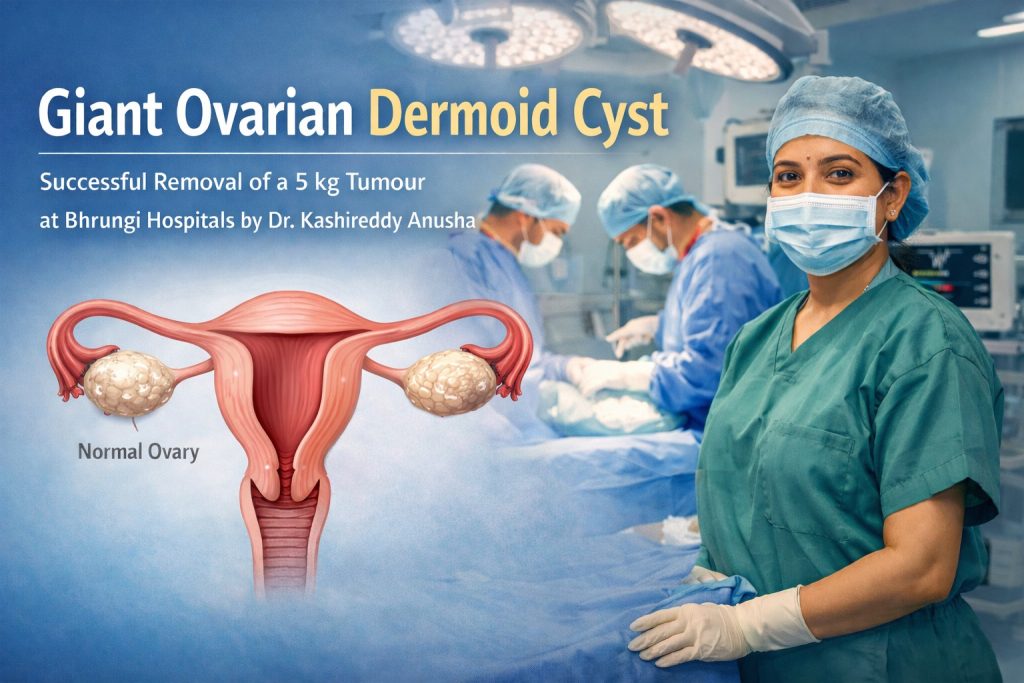
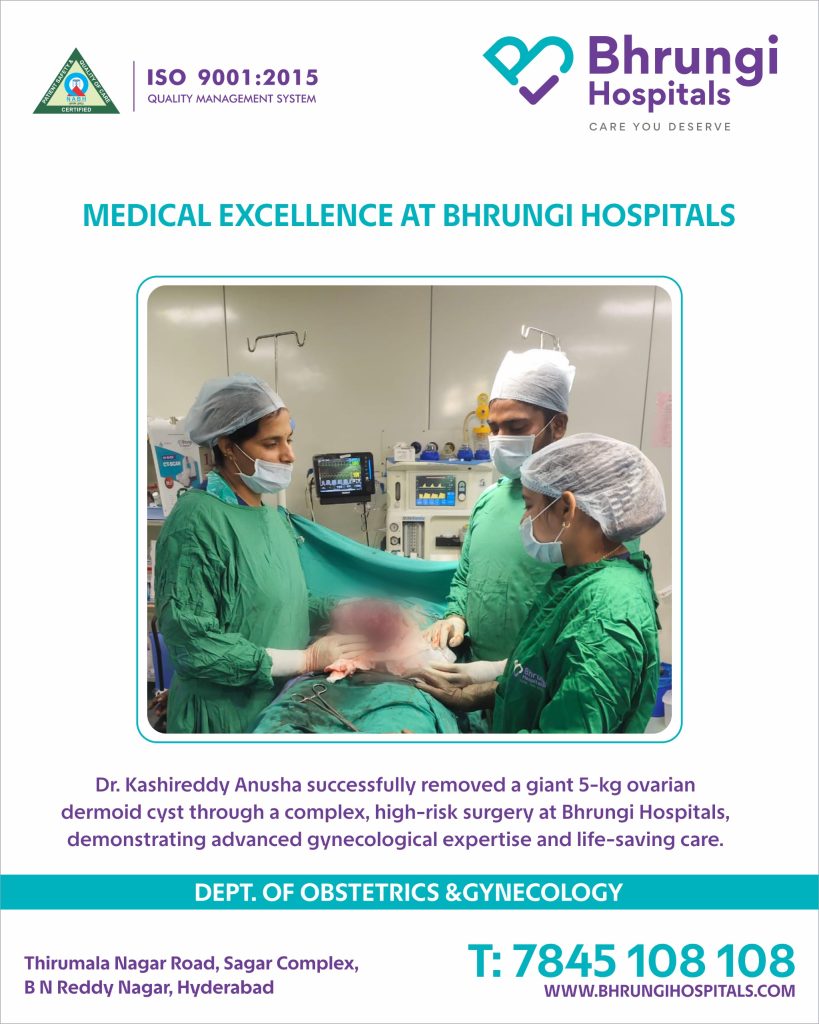
A Giant Ovarian Dermoid Cyst is a rare but a critical gynaecological occurrence which requires expert surgical intervention. In a recent successful operation a massive giant ovarian dermoid cyst weighing nearly 5 kgs and measuring 22 × 16 × 12 cms was expertly removed at Bhrungi Hospitals, Vanasthalipuram, Hyderabad. The complex and intricate procedure was safely performed by Dr. Kashireddy Anusha, Consultant Obstetrician, Gynaecologist, and Laparoscopic Surgeon, world-class expertise in managing complex ovarian tumours.
What is a Giant Ovarian Dermoid Cyst?
A giant ovarian dermoid cyst, also called a giant mature cystic teratoma, is among the more common benign germ cell tumours of the ovary. These cysts originate from germ cells and contain markedly differentiated, mature tissues which are derived from at least two or often all three- embryonic germ layers.
Tissue Components Found in Dermoid Cysts
-
Ectodermal Elements:
These are the most common and include skin, hair, teeth, and sebaceous (oily) material. A characteristic solid projection called the Rokitansky nodule often contains hair or teeth. - Mesodermal Elements:
The complex structure of the Cyst may also be attributed to Cartilage, bone, and fat which may be present within the cyst. - Endodermal Elements:
Occasionally Respiratory epithelium, intestinal tissue, or even thyroid tissue can also be identified.
In most ovarian dermoid cysts, the growth is slow, which is an average rate of about 1.8 mm per year, and typically measure between 6 to 10 cms. Nearly 10 to 20% of all ovarian tumours can be accounted for in this category and commonly occur in women of reproductive age, though they can be seen sometimes in children and postmenopausal women. On an average, 8 to 15% of cases may be bilateral.
Why is the name Dermoid Cyst called “Giant”?
A cyst is called a giant when it is larger than 15 cms in diameter. Giant ovarian dermoid cysts are surgically challenging because of their huge size, the probable risk of twisting or torsion, rupture and pressure effects on surrounding organs. Careful planning and surgical expertise are of greatest importance for safe removal with minimum complications.
Clinical Presentation of Giant Ovarian Dermoid Cyst
While smaller dermoid cysts are often asymptomatic and discovered incidentally on ultrasound, larger or giant cysts commonly present with noticeable symptoms, including:
- Increasing abdominal distension or a palpable abdominal mass
- Abdominal or pelvic pain
- Symptoms of pressure like urinary frequency, constipation, or venous compression
Diagnosis of Ovarian Dermoid Cysts
Imaging Studies
- Ultrasound typically shows classic features such as an echogenic dermoid plug, fat-fluid levels, calcifications representing teeth or bone, and the “tip of the iceberg” sign.
- CT scan or MRI confirms the presence of fat, which is the diagnostic hallmark, along with heterogeneous tissue components and calcifications.
Laboratory Tests
Tumor markers like AFP, β-hCG, and LDH are usually normal, helping rule out malignant or immature germ cell tumours. Definitive diagnosis is always confirmed through histopathological examination after surgical removal.
Treatment and Prognosis
Surgical excision is the gold standard treatment for a giant ovarian dermoid cyst. Depending on the patient’s age, tumour size, and ovarian involvement, the procedure may involve cystectomy to preserve ovarian function While laparoscopy is preferred for smaller cysts, open laparotomy is often required for giant tumours.
The prognosis is excellent, as these tumours are benign. Recurrence is rare when the cyst is completely excised.
World-Class Expertise at Bhrungi Hospitals
The vast experience of Dr. Kashireddy Anusha (MBBS, MS – Obstetrics and Gynaecology, FMAS, IMA Fellowship in Infertility), made it possible for the complex surgery to be conducted with precision and care. Under her excellent expert hands and rich expertise in gynaecology and minimally invasive surgery ensured complete tumour removal with optimal postoperative results. The patient now recovering steadily and is thankful for the physical relief and renewed confidence.
At Bhrungi Hospitals, managing such a rare and challenging giant ovarian dermoid cyst is an example of the institution’s commitment to excellence, innovation, and compassionate healthcare, offering patients a new lease on life even in the most complex clinical conditions.